
Central Florida Marine Construction Company
Docks, boathouses, seawalls, pilings and boat lifts — designed, permitted and built by one marine contractor with its own crews and equipment, coast to coast across the middle of Florida.
Service
Marine Construction Is Where JSC Started
JSC Contracting Inc is Central Florida’s marine construction company. Docks, boathouses, seawalls, pilings and boat lifts are not a side business for us — they’re the work this company was built on. Everything else we do came later, because customers who watched us build on the water kept asking us to build on land too.
Marine construction is simply building in, on and against water — and it is a different trade from building on dry ground. Every structure starts below the waterline, in a bottom you cannot see, and then has to survive wake, current, seasonal water swings, storm surge and, on the coast, salt. There is no slab to build on and no do-overs once the pilings are set. Your contractor has to read the water body first and design second.
We do all of it in-house: our own marine crews, our own barges and piling equipment, our own permitting, and one point of contact from the first site walk to the day you tie a boat to it. No salesman handing your job to whoever was available that week.


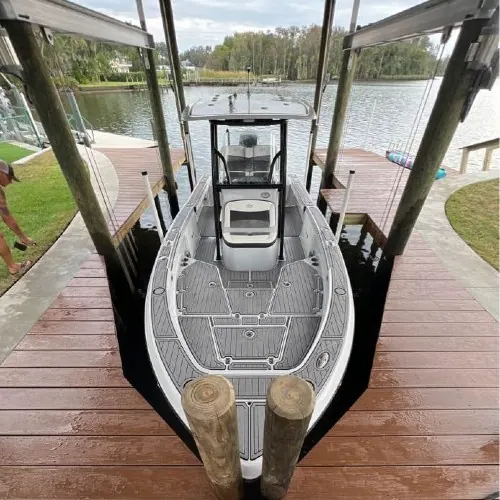
REAL JOBS ONLY Every photo on this page is a real JSC job — no stock photos. Browse all of our project galleries →
Docks & Boathouses
A dock is the front porch of your waterfront — and no two of ours are the same. Straight walkways, platform docks, two-story docks with viewing decks, wood or composite, on lakes, rivers, and coastal water. As custom dock builders in Central Florida, we handle the site prep, the permitting, the pilings, and the build itself — no subcontractor roulette.
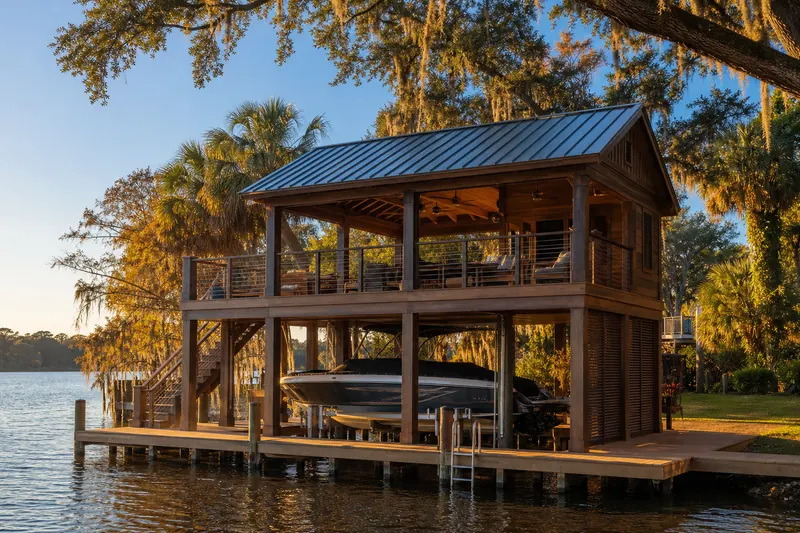
Want your boat covered too? We’re also a full Central Florida boathouse builder. A boathouse protects your boat from sun and storm, adds real property value, and — built right — becomes the best-looking structure on the shoreline. Docks and boathouses designed together always come out better than ones bolted together later, because the roof loads and the lift loads land on pilings that were sized for them from the start.


Seawalls & Shoreline Protection
The other half of marine construction is the part you don’t see from the water: the engineering holding your shoreline in place. Our seawall construction and repair work covers new walls in wood or galvanized steel, anchored tie-back systems, concrete caps, and repairs to walls that are bulging, cracking, or washing out behind.
A seawall fails from the back, not the front. Water gets behind the wall, carries the soil out through a failed joint or a rusted tie rod, and the lawn starts sinking long before the wall visibly leans. That is why the cheapest seawall work is always the work you do early. When soil conditions call for it, we bring in a geotechnical engineer so the design is calculated, not guessed.
Boat Lifts
Keeping your boat out of the water when you’re not using it is the single best thing you can do for it. We handle boat lift installation and repair — new installs, replacements, and upgrades for everything from a pair of jet skis to lifts rated at 38,000 lbs. We’ve set lifts for 70-foot boats at Crystal River.
Because we’re a full marine construction company and not just a lift dealer, we can also reinforce the dock or add the pilings a bigger lift needs — one crew, one contract, one finished job. A lift is only ever as strong as what it is bolted to, and most of the tired lifts we are called out to look at are really tired pilings.

The Foundation
Dock Pilings: The Part Nobody Sees
Every dock, boathouse and lift on this page stands on pilings, and the pilings are where a marine job is won or lost. Everything above the water is carpentry. Everything below it is the reason the carpentry is still there in twenty years.
Most Central Florida docks sit on pressure-treated wood pilings, which are cost-effective and, in freshwater, long-lived. Concrete pilings cost more up front and earn it back in saltwater or anywhere boat traffic makes impact likely. Composite sleeves and wraps protect the waterline zone on both — the few inches above and below the surface where wood gives up first.
How deep a piling goes is decided by the bottom, not by a catalogue. A clean sandy bottom like Lake Weir’s takes a jetted piling quickly and holds it well. Muck means going deeper to find something that actually bears load. Rock and clay out toward the Nature Coast can mean drilling instead of jetting — slower, and the single biggest reason two docks of the same size quote differently.
The number of pilings drives your price more than the decking does, which is why we count them on site rather than over the phone. Already have pilings that are leaning, spongy at the waterline, or spinning when you push on them? That is a repair conversation, and it is covered on our dock and boat lift repair page — wraps and replacements are far cheaper than the deck they hold up.

Permitting
Who Has to Say Yes Before You Build
Building on the water in Florida means asking permission from more than one agency, and the list changes with the water body your property sits on. This is the part of marine construction that stalls homeowners who try to run it themselves — and the part we handle for you as a matter of course. Depending on the job, that can mean:
- Your county building department — the structural permit and inspections, same as any other build. Marion, Lake, Citrus, Sumter, Alachua and Putnam each run this slightly differently.
- The water management district — St. Johns River Water Management District over most of our territory, Southwest Florida Water Management District out toward Crystal River, the Rainbow River and the Withlacoochee.
- The Florida Department of Environmental Protection — where the structure sits over state-owned submerged land, which is most public lakes and rivers.
- The U.S. Army Corps of Engineers — for federally navigable waters.
- Your HOA or lake association — not a government body, but the one most likely to make you move a piling after the fact if you skip it.
The good news: most private single-family docks are modest enough to qualify for a streamlined authorisation rather than a full individual permit. Outstanding Florida Waters — the Rainbow and Crystal rivers among them — are held to a tighter standard, and that is worth knowing before you fall in love with a design. We confirm what your specific water body requires before we quote, so the number you get is the number for a dock that can actually be built there.
The Process
How a Marine Construction Job Actually Runs
No surprises is the whole idea. Here is the shape of nearly every project we build on the water:
- 1. We walk your waterfront with you. We look at the water, the bottom, the setbacks, your shoreline and how you actually use the property. Our goal is to quote most projects right there on site.
- 2. We design to the water body. Length, height above the waterline, walkway width, piling count and materials all come out of what we saw on the site walk — not a template.
- 3. We run the permitting. County, water management district, and state or federal authorisation where the job needs it. You sign; we chase.
- 4. We mobilise. Barge and piling equipment on the water, or land access where the lot allows it. This is the step most “dock companies” have to rent or sub out.
- 5. Pilings first, then structure. Pilings are set and cut to grade, then framing, decking, roof, lift and any electrical or water lines.
- 6. We walk it with you before we call it done. Punch list closed on site.
Through all of it you are in a group chat with the crew building your project, which is the single change that has done the most to keep our jobs from going sideways. Ask a question at 7am, get an answer with a photo. We hold to our quotes.
Where We Build
The Water Decides the Build
We’re based in Ocala and our marine crews work coast to coast across the middle of the state — Orlando to Gainesville, Daytona to Crystal River, and every lake and river in between. Freshwater, spring-fed and salt each wear on a structure differently, and we build for the water your property actually sits on:
- Central Florida lakes — sheltered water, seasonal level swings, and bottoms that run from clean sand to deep muck within the same lake. Building a dock on Lake Weir is our home-lake write-up; building a dock on Lake George covers Florida’s second-largest lake, where wind and waves call for long walkways and serious engineering.
- Spring-fed rivers — the Rainbow and the Silver run cold, clear and constant, with current that never stops working on a piling and environmental rules that are stricter than anywhere else we build.
- The Gulf and the Nature Coast — Crystal River, Homosassa, Yankeetown. Salt chews hardware and lift cables on a schedule freshwater owners wouldn’t believe, and rock bottoms make piling work slower. Our Crystal River seawall inspection guide covers what to watch for out here.
- The St. Johns and the Atlantic side — tidal influence, boat traffic and canal frontage, where dock height and fender protection matter more than they do on a quiet lake.
Lake Weir, the Harris Chain, Lake Kerr, Lake George, the Rainbow River, Crystal River and the Nature Coast, the St. Johns, and canal-front and coastal properties on either side of the state. Curious what a build costs before you call? What a dock costs in Central Florida uses real pricing from our own jobs. If there’s water on your lot, we can build on it — there’s no job too big or small.
Why Hire JSC as Your Marine Contractor?
Most “dock companies” are either a salesman with subcontractors or a handyman with a barge. JSC is neither. We’re a Florida certified residential contractor (CRC1332267) with 25+ years of construction experience, our own marine crews and equipment, and a portfolio that runs from single-slip lake docks to dual-lift coastal boathouses. When you call, you get a builder — not a middleman.
It also means we can do the whole waterfront. A seawall, a dock, a boathouse and a lift from four different companies is four warranties, four schedules and four people to blame. From us it is one contract and one crew, and the pilings under the lift were sized for the lift on day one. Whatever else you need built once you’re off the water — we do that too. You dream it. We build it.
Marine Construction Questions We Hear Most
Straight answers to what Central Florida waterfront owners ask us before they call.
What does a marine contractor actually do?
Do I need a permit to build a dock in Florida?
How deep do dock pilings go?
Wood or concrete pilings — which should I use?
How long does a marine construction project take?
Do you work in saltwater as well as freshwater?
Do you take on repairs, or only new builds?
What areas do you cover?
Design Your Dock Online
Pick your shape, decking, railings, boat lift, roof and lighting in about 10 minutes. When you send it, you get a picture of your dock and our estimators get your selections.
Get Your Free Estimate Today!
Call 352.687.2030 or send us your project details online — we’ll review your marine project and get you a free price estimate.
GET A FREE ESTIMATE