
Seawall Inspection Guide: Crystal River & the Nature Coast
We build seawalls on both sides of the divide — the spring-fed lakes inland and the salt and brackish water out on the Gulf — and the two are not the same job. A wall that would give you forty quiet years on a Marion County lake can be visibly failing in fifteen on Kings Bay, on the Homosassa, or out toward Ozello. Same panels, same crew, same care. Different water.
Which means the annual walk you take along your seawall out here has to look for different things, in a different order, at a different time of day. If you own waterfront in Crystal River, Homosassa, Inglis, Yankeetown, or anywhere along the Nature Coast, here’s the inspection that actually fits your shoreline.
If you’re inland on a lake, start with our general Central Florida seawall inspection checklist instead — the seven signs there apply everywhere. This guide is what gets added on top when the water is salty.
The short answer: walk your own wall once a year at low tide, check the seven things below, and put professional eyes on it every three to five years — sooner the moment a cap starts staining rust or the yard starts dropping. On salt water a seawall fails from the bottom up and the inside out, so when you look matters as much as what you look for.
Why the Nature Coast Is Harder on a Seawall
Four things change the moment your water has salt in it, and each one shortens the life of something.
| Central Florida lake | Crystal River & the Nature Coast | |
|---|---|---|
| Water | Fresh — mild on steel and concrete | Salt or brackish — chlorides attack reinforcing steel |
| Water level | Moves seasonally, over months | Tides twice a day, every day — constant wet/dry cycling |
| Bottom | Often sand — pilings and sheets drive fast | Limestone rock and hard bottom — slow, grinding installation |
| Biology | Minimal | Barnacles, oysters, and marine borers in untreated wood |
| Storm threat | Wind-driven wave and saturated soil | Storm surge over a very shallow, very flat shelf |
The tidal line is the one homeowners underrate. Seasonal level change on a lake soaks a wall and lets it dry out a couple of times a year. A tide does it roughly twice a day, forever. That cycle is what drives salt deep into concrete and what slowly pumps soil out through every joint and weep hole behind the wall. It isn’t dramatic on any given day, which is exactly why it goes unnoticed until the yard drops.
Inspect at Low Tide — Everything Else Is Guessing
This is the single most useful piece of advice in this article, and it costs you nothing but timing. Walk your seawall at low tide. Preferably a low tide on a calm, clear day.
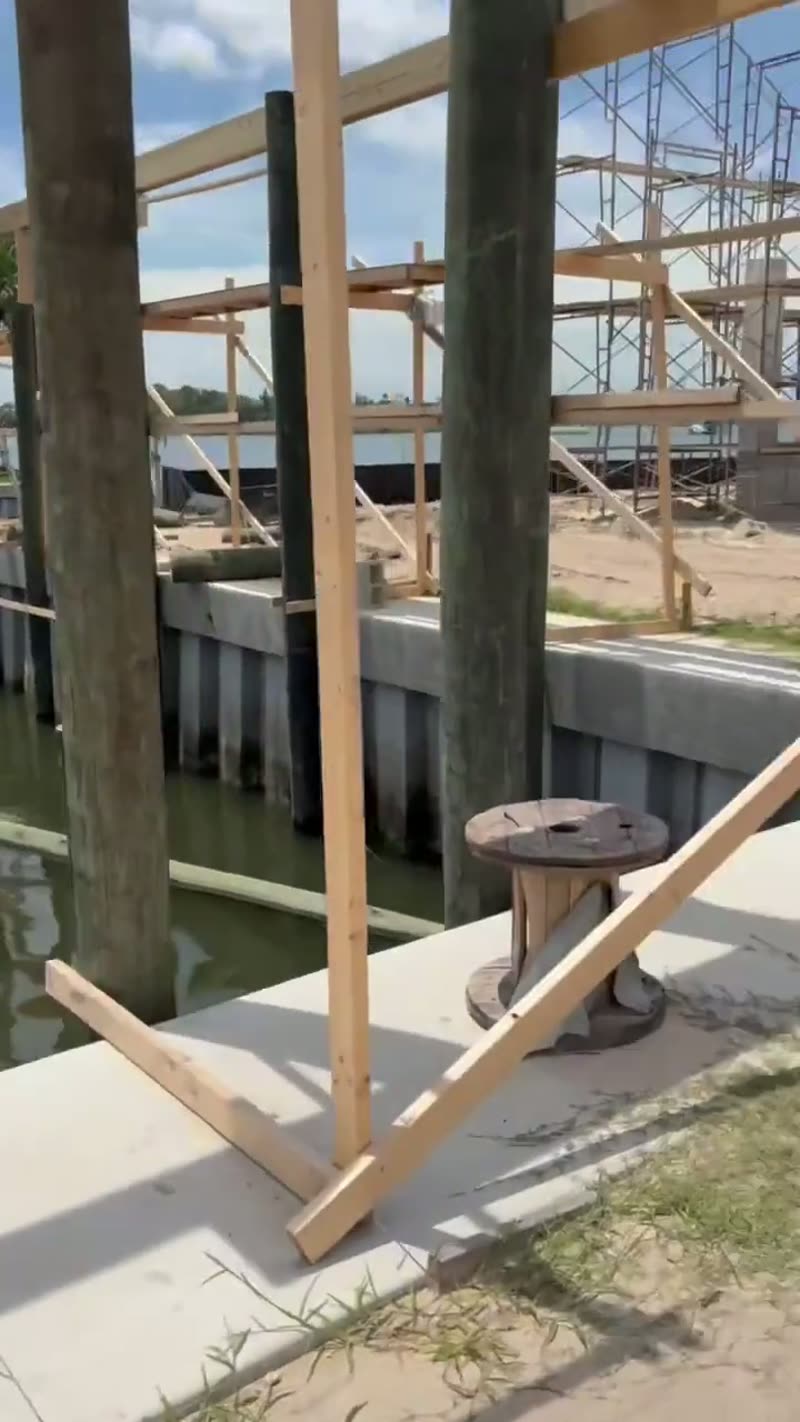
Nearly everything that matters on a coastal wall lives in the band that is normally underwater: the base of the panels, the toe where the wall meets the bottom, the scour pocket that forms in front of it, the joints below the waterline that have started passing sand. At high tide you can inspect the cap and nothing else, then walk away satisfied. Homeowners do this every year and it is the reason so many walls fail “without warning.”
Pick a day with a good low, take a phone, and photograph the same three or four spots each year from the same standing position. Change over time is the whole diagnosis.
What to Look For, Salt-Water Edition
1. Rust stains and spalling on a concrete cap
On a lake, a hairline crack in a concrete cap is usually just a crack. Out here, a crack with a rust-colored stain weeping from it is telling you chloride has reached the reinforcing steel. Steel expands as it corrodes, which cracks the concrete from the inside, which lets in more salt water. Left alone, the cap begins shedding chunks — spalling — and the exposed rebar goes fast after that. Brown staining on a cap is not cosmetic. It’s a clock.

2. Gaps and open joints between panels
Look at the vertical seams between panels, all the way down at low tide. On a tidal wall, any gap is a two-way pump: water pushes in on the flood, and on the ebb it pulls soil out with it. A joint you can slip a finger into is moving cubic feet of your yard into the bay every single day.
3. Soft spots, dips, and holes in the yard behind the wall
This is the same soil arriving somewhere it can be seen. A depression parallel to the wall, a low spot that keeps coming back after you fill it, grass that squelches when nothing else does, a sprinkler head that has sunk an inch — all of it means a void has opened behind the panels. It is the most common thing we get called out for on the Nature Coast, and by the time it is visible at the surface, the void has been growing for a while.

4. A wall that is leaning out toward the water
Sight down the cap from one end. A seawall is held back by tiebacks running to buried anchors, and in salt water those connections corrode faster than anything else on the structure. A wall that has begun to rotate at the top is telling you the restraint system is losing. This is the failure mode that goes from “noticeable” to “emergency” fastest, and it is not a wait-and-see item.
5. Blocked or missing weep holes
Weep holes let water pressure behind the wall bleed off. Behind each one there should be filter fabric doing the opposite job — letting water through while holding soil back. When the fabric fails, the weep hole becomes a drain for your yard. When the weep holes clog instead, water pressure builds behind the wall with nowhere to go, and on a falling tide that pressure has to push somewhere. Both failures are common. Both are cheap to fix early.
6. Scour at the toe
At low tide, look at where the wall meets the bottom. Current and boat wake carve a trench there over time. If the bottom in front of your wall is noticeably lower than it used to be, or lower than your neighbor’s, the wall is losing the support it was designed to have at its base. On the rock bottoms common around Crystal River, scour tends to concentrate in the softer pockets rather than spreading evenly, so check the whole run and not just one spot.
7. Barnacles, oysters, and borers
Marine growth on the panels is normal and mostly harmless, but it hides everything under it — clear a patch before you decide a section is fine. What is genuinely destructive is what happens to untreated wood in salt water: marine borers hollow it out from the inside, leaving a member that looks sound and has almost nothing left in the middle. Any timber component on a coastal wall — whalers, caps, older wooden walls — deserves a probe with a screwdriver, not just a look.
Repair or Replace?
The honest answer is that it depends on what is failing, not on how bad it looks.
Cap cracking, isolated spalling, blown filter fabric, a clogged weep-hole run, localized voids behind the wall, toe scour — these are repairs. They are far cheaper than replacement, and catching them is the entire reason for an annual walk. There’s no minimum job — “just fix the bad section” is a real option on a seawall, same as it is on a dock.
Panels that are visibly bowing, a wall rotating along a long run, corroded tiebacks failing in more than one place, or a wooden wall with borer damage through its structural members — those are usually replacement conversations. Patching a wall whose restraint system is going is money spent on a countdown. We say this about docks too, in dock and boat lift repair: fix it or replace it, and it applies double on a seawall, because a seawall failure takes your yard with it.
Permitting Out Here Is Its Own Project
This is where a Nature Coast seawall really separates from a lake seawall, and where homeowners get surprised.
Inland, a private-lake wall generally means the county and the water management district. On the Gulf side of Citrus, Levy, and Hernando counties you can be dealing with several more layers at once: the Florida Department of Environmental Protection for the environmental resource permit; separate proprietary authorization if the work touches state-owned submerged lands, which most coastal walls do; the Army Corps of Engineers for work in navigable waters; and, in this particular corner of Florida, the aquatic preserve designations that cover much of the Nature Coast shoreline — St. Martins Marsh and the Big Bend seagrasses among them.
Add manatees. Kings Bay is the manatee capital of the state, and in-water construction here routinely carries protection conditions on timing and method. None of this makes a project impossible. It makes it a project with a lead time, and it is the reason “we’ll just knock it out next month” rarely survives contact with reality on this coast.
Requirements vary by parcel and by what you’re actually doing — repair in kind is treated differently from a new or relocated wall — so confirm your specific scope before you plan a timeline. We handle the permitting on every seawall construction and repair project we take, which is a large part of why people hire us out here instead of doing it themselves.
Who We Are on This Coast
JSC Contracting is a Central Florida marine contractor — seawalls, docks, boathouses, and boat lifts — working across Marion, Lake, Sumter, Putnam, and Citrus counties. That range is deliberate: we build on sheltered sandy lakes like Lake Weir and on hard-bottom salt water out at Crystal River, and knowing how differently those two behave is most of the job. Coastal work runs bigger in every direction — boathouses out here sometimes hold boats up to 70 feet, on lifts in the 28,000–38,000 lb class — and we publish real 2026 dock pricing, waterway by waterway, because that’s how we think numbers should be handled. Our full marine construction work covers the whole shoreline, not just the wall.
If your walk turned up any of the seven items above — or if you just want someone to look at it at low tide who has repaired a few hundred of them — get a free estimate. We quote on site, from your actual shoreline. You dream it. We build it.
Nature Coast Seawall Questions, Answered
How often should I inspect a seawall in Crystal River?
At least once a year, and again after any named storm that pushes surge into your bay. Do the annual walk at low tide on a calm day, and do it before hurricane season rather than after — a repair booked in April is a different price and a different wait than the same repair booked in October, when every contractor on the coast is triaging.
How long does a seawall last on the Nature Coast?
Less than the same wall on a freshwater lake, and the gap is mostly about salt reaching reinforcing steel and about tidal cycling working the joints. Vinyl and composite panel systems hold up well in salt because there is no steel in the panel itself to corrode; on those walls, the tiebacks, the connections, and the cap become the life-limiting parts. Age alone is a poor predictor — how the wall was specced for salt, and whether small failures were caught early, matters far more.
Why does my yard keep sinking behind an intact-looking seawall?
Because the failure is below the waterline where you can’t see it. Soil is escaping through open panel joints, failed filter fabric behind the weep holes, or a gap at the toe, and the tide is pumping it out a little at a time. The wall face can look perfect while the ground behind it hollows out. Fill dirt is treating the symptom; the fix is finding and closing the path the soil is taking.
Do I need a permit to repair a seawall in Citrus County?
Usually yes, and often from more than one agency — the county, FDEP, potentially the Army Corps, plus authorization if the work touches state-owned submerged lands, with additional conditions inside aquatic preserves and manatee areas. Repair in kind is generally treated more simply than new construction or a relocated wall, but the specifics depend on your parcel and scope. We pull the permits on the projects we build; if you're pricing a job, ask any contractor to tell you exactly which approvals your scope needs before you sign.
Are rust stains on my seawall cap serious?
Treat them as serious. A rust-colored stain weeping from a crack means salt has reached the reinforcing steel inside the concrete and the steel is corroding and expanding. That expansion cracks the cap further and accelerates the process. Caught early it's a repair; ignored, it becomes spalling, then exposed rebar, then structural.
Is a rock bottom a problem for a seawall?
Not a problem, but it is a cost and schedule driver. Sheet pile and pilings drive quickly into the sand bottoms common on inland lakes; the limestone and hard bottom around Crystal River takes considerably more time and equipment to get through, and it changes how the toe and anchors have to be designed. It's one of the main reasons a coastal seawall quote and a lake seawall quote for the same length of wall are not comparable numbers.