
Dock Permit Requirements in Florida: What Slows Projects Down
The dock is the fast part. Two to four weeks of actual building on most lakes, depending on how far out your water makes us go. What nobody budgets for is the three or four months in front of that, when nothing is happening on your shoreline and three separate agencies are deciding whether you’re allowed to drive a piling.
We get the call every spring. Somebody closed on a waterfront lot in February and wants to be fishing off a new dock by Memorial Day. Sometimes that works. More often the honest answer is: not on this water, not with that boathouse, not this year. And the reason is almost never the build — it’s the permit.
So here’s the plain-language version of what Florida actually requires, and the specific things that stall dock projects. We pull these permits every week across Marion, Lake, Sumter, Citrus, Putnam, and Volusia counties, so this is what the process looks like from our side of the counter.
The Short Answer: Three Agencies, a 1,000-Square-Foot Line, and 30 to 90 Days
A residential dock in Florida can need sign-off from three separate layers — your county or city building department, the state (either the Florida Department of Environmental Protection or the water management district that covers your water), and the U.S. Army Corps of Engineers.
The single number that decides how painful that gets is 1,000 square feet. A private, single-family dock at or under 1,000 square feet of over-water surface generally qualifies for a state exemption, and from there most standard residential docks move on a general permit with a $250 filing fee. Plan on 30 to 90 days from a complete application to a permit in hand. Cross that square-footage line — usually with a boathouse, a second slip, or a big terminal platform — and you’re into individual-permit territory, where review is measured in months. In Outstanding Florida Waters like the Rainbow River, the line drops to 500 square feet.
Who Actually Has to Say Yes
Almost every homeowner we talk to knows about one of these three. Missing either of the other two is the most common reason a dock project goes back to zero.
| Layer | Who | What they’re looking at | Typical review |
|---|---|---|---|
| Local | County or city building department | Setbacks, riparian lines, structural and wind code, floodplain, zoning | 2–6 weeks |
| State | FDEP, or the water management district for your water (SJRWMD or SWFWMD) | Environmental resource permit or exemption, plus consent to occupy state-owned submerged land | ~30 days exempt or general; months for an individual permit |
| Federal | U.S. Army Corps of Engineers, Jacksonville District | Navigable waters, wetlands, protected species | Usually folded into the state review; months when it can’t be |
That third row is the one people don’t expect. Most small residential docks never see an individual Corps review because Florida and the Corps run a joint program that lets the state review qualifying structures on the Corps’ behalf. It works quietly and it works well — right up until your dock doesn’t qualify, at which point the federal review is its own project with its own calendar.

The 1,000-Square-Foot Line — and What “Exempt” Doesn’t Mean
Florida carves private residential docks out of full environmental permitting when they stay small and stay simple. The conditions that matter most:
- 1,000 square feet or less of over-water surface in most waters — 500 square feet or less in Outstanding Florida Waters.
- Private, non-commercial, single-family use. Not a marina, not a rental operation, not a shared community dock.
- One dock per parcel.
- No dredging or filling beyond what it takes to install the pilings.
- It can’t impede navigation or block the flow of water.
Here’s the part that catches people out. “Exempt” means exempt from one permit, not exempt from paperwork. A dock that qualifies still typically needs authorization to occupy state-owned submerged land, still needs a county building permit, and still has to be covered on the federal side. Nothing about the word “exempt” means you can start driving pilings on a Saturday.
And we ask for the exemption in writing, every time. A verbal “you’re probably fine” from someone at a counter is worth nothing on the day a neighbor files a complaint or a title company asks for documentation at closing.
What Pushes a Dock Over the Line
Every item below is a good thing to own. Every one of them also costs you calendar:
- A boathouse or covered slip. The single most common reason a dock leaves the exemption lane — a roof adds real square footage fast. Worth it anyway; see how we approach boathouse construction in Central Florida.
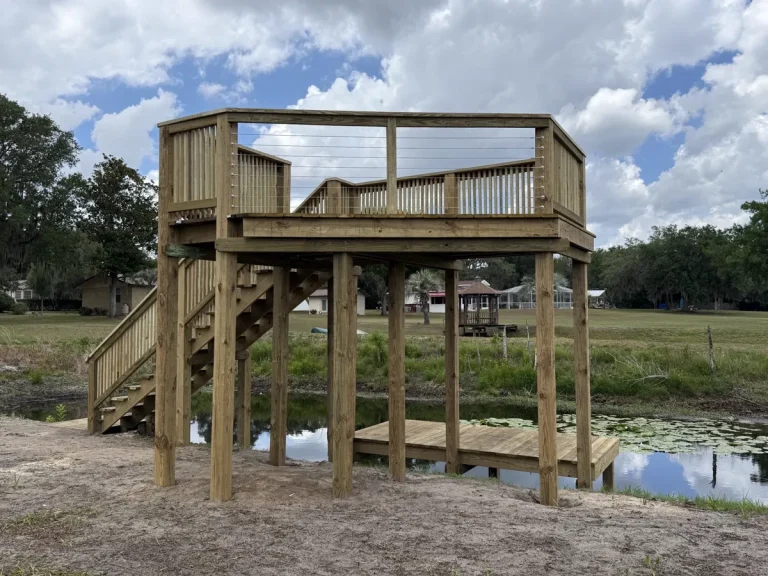
- A second story or viewing deck. Elevated decks are one of our favorite things to build and one of the surest ways to trigger a longer review.
- More than one slip. Two boats means more structure, and in some counties it also means a density review under a local manatee protection plan.
- A wide terminal platform. Square footage is square footage. A generous L or T head is where a lot of “simple” docks quietly cross 1,000 feet.
- Dredging to reach depth. The moment you move bottom material, the exemption is gone.
- Shoreline work bundled in. A seawall or riprap installation permitted alongside the dock is a separate environmental question with its own conditions.
- An oversized lift. Boat lifts are usually straightforward, but the pilings and cradle for a 30,000-pound coastal lift are not the same application as a 4,500-pound lake lift.
None of that is a reason to build less dock than you want. It’s a reason to start the conversation earlier — and to price the wait honestly before you commit. Our full breakdown of what a dock actually costs in Central Florida covers the money side of the same decisions.

Six Things That Actually Slow Projects Down
1. An incomplete application
This is the big one, and it’s boring, which is why it keeps happening. When a reviewer sends a request for additional information, the clock doesn’t keep running while you gather it — the file sits, and when you respond, review effectively starts over. Two rounds of that turns a 30-day permit into a four-month permit without a single agency ever saying no. A complete first submittal is the cheapest time you will ever buy.
2. Proving where the state’s land stops and yours starts
Below the mean high water line on most navigable water in Florida, the bottom belongs to the state. Your dock sits on it, which means you need consent to be there. That consent depends on a defensible line on a survey, and if your survey is old, vague, or missing, everything downstream waits on a surveyor.
3. Manatees
Several Florida counties operate manatee protection plans that limit slip density and add conditions to in-water work. Citrus County and Kings Bay are the obvious example out on the coast, but this reaches inland spring runs too. Expect seasonal work windows, observer requirements, and specific conditions attached to your permit — not a denial, but not something you can schedule around after the fact either.
4. The setback your neighbor cares about
Docks generally have to be set back from the riparian lines that divide your water frontage from your neighbors’ — commonly 25 feet, with exceptions for narrow lots. On a wide lot nobody thinks about it. On a 60-foot lot it can decide the entire shape of your dock, and it’s far cheaper to find that out before drawings than after.
5. HOAs and deed restrictions
Not a government agency, and not our department, but it stops jobs anyway. Some waterfront communities restrict dock length, roof height, lighting, or lift type in ways that are stricter than anything the county requires. Read yours before you fall in love with a design.
6. When you apply
Permit offices get buried after a named storm, and everyone on the lake decides they want a dock in the same three months of spring. Applying in the fall of one year to build in the spring of the next is not over-planning — it’s just how the calendar works on the water.
Outstanding Florida Waters and the 500-Square-Foot Half
Florida designates certain waters as Outstanding Florida Waters, and separately designates aquatic preserves, both of which carry tighter rules. The Rainbow River is the local one that surprises people most — it is spectacular water, it is heavily protected, and the dock you can build there is smaller than the one you could build on a lake ten miles away. Kings Bay in Crystal River carries its own layered conditions.
If you’re on protected water, the design conversation has to start at the rules and work outward, not start at the dock you want and hope. That’s true across our whole marine construction practice, from docks to seawalls.
What This Looks Like Water by Water
Permitting isn’t uniform across Central Florida, because the agencies aren’t. A few examples from water we work on constantly:
- Lake Weir (Marion County). St. Johns River Water Management District, sandy bottom, well-worn process. Most standard residential docks here clear on a general permit. We wrote up the whole build in our guide to building a dock on Lake Weir.
- Lake George (Putnam and Volusia counties). Two counties plus SJRWMD, and often FDEP on top, because the lake is part of the St. Johns system. Add the fact that walkways average 800 feet to reach depth and the square footage math gets interesting fast — see what it takes to build a dock on Lake George.
- Crystal River and the Nature Coast (Citrus County). Southwest Florida Water Management District, coastal and tidal, aquatic preserve conditions, manatee conditions, and a rock bottom that changes the engineering. The longest lead times we deal with.
- The Rainbow River (Marion County). Outstanding Florida Water. Smaller footprint, more scrutiny, worth every bit of the care.
Repairs Are a Different Permit — and Usually a Much Easier One
Worth knowing before anyone sells you a new dock: maintaining or repairing an existing, legally permitted dock in its same footprint is generally treated far more simply than putting up a new structure. Replacing decking, swapping bad pilings, fixing storm damage — that’s a different and lighter conversation with the agencies than a new build.
The flip side, and this is the part contractors don’t always volunteer: rebuild it bigger, move it, or change its shape, and you’ve created a new structure. You’re back at the front of the line with the full review. If your dock is tired but the layout still works, say so out loud before anyone draws anything. Our guide to when to repair a dock or boat lift and when to replace it walks that decision symptom by symptom.
The Honest Version
Two things we’ll tell you that don’t help us sell a dock.
Sometimes the answer is wait. If you want a boathouse on protected coastal water and you’re calling us in April about summer, we’re going to tell you the timeline is next year. We’d rather lose that argument in April than manage your disappointment in July.
Sometimes the answer is build less. If a slightly smaller platform keeps you under 1,000 square feet, and you don’t actually need the extra 80 feet of decking, that trade can save you months. We’ll draw it both ways and show you where the line falls, because the version you can actually build this year is usually worth more than the version you’re still waiting on.

We Pull the Permits. That’s the Job.
The applications, the drawings, the surveys, the agency correspondence, the responses to requests for information, the inspections — that’s our work, not yours. We’ve pulled enough dock permits across Marion, Lake, Sumter, Citrus, Putnam, and Volusia counties to know what each office wants before we walk in the door, and knowing that is most of the speed.
Come look at docks we’ve built across Central Florida, see how we build docks, then get a free estimate or call (352) 687-2030. We quote on site, from your actual shoreline, and we’ll tell you what your water will and won’t allow before you sign anything. You dream it. We build it.
Florida Dock Permit Questions, Answered
Do I need a permit to build a dock in Florida?
Almost always, yes — and usually more than one. A residential dock can require a county or city building permit, a state environmental authorization or exemption from FDEP or your water management district, consent to occupy state-owned submerged land, and federal coverage through the Army Corps of Engineers. Small private docks move through a streamlined path, but “no permit at all” is essentially never the answer on navigable water.
How big can a dock be in Florida without an environmental permit?
Generally 1,000 square feet or less of over-water surface for a private, single-family, non-commercial dock — and 500 square feet or less in Outstanding Florida Waters. The dock also has to be one per parcel, involve no dredging or filling beyond piling installation, and not impede navigation. Qualifying for that exemption does not remove the county permit or the submerged-lands authorization.
How long does a dock permit take in Florida?
Plan on 30 to 90 days from a complete application for a standard residential dock, and several months if the project needs an individual permit or a separate federal review. The biggest variable isn’t the agency — it’s whether the first submittal was complete. Every request for additional information adds weeks.
How much does a dock permit cost in Florida?
Most standard residential docks in our area move on a general permit with a $250 filing fee, plus county building permit fees that vary by jurisdiction and project value. Surveys, engineered drawings, and any specialty studies are separate. Individual permits cost meaningfully more and take meaningfully longer.
Does a boathouse need a different permit than a dock?
Usually it changes the review rather than adding a separate permit. A roof adds over-water square footage, which is the most common way a dock exceeds the exemption threshold and moves into a longer individual review. Some counties also apply height, setback, and manatee-plan conditions specifically to covered structures.
Do I need a permit to repair an existing dock?
Usually something, but far less. Maintenance and repair of an existing, legally permitted dock within its same footprint — decking, pilings, storm damage — is generally handled much more simply than new construction. Rebuilding larger, relocating, or changing the shape creates a new structure and puts you back through the full review.
Who owns the bottom of the lake under my dock?
On most navigable water in Florida, the state does. Below the mean high water line the submerged land is state-owned, which is why a dock needs authorization to occupy it even when the environmental permitting is exempt. Establishing that line accurately on a survey is one of the quiet prerequisites that delays projects when it’s missing.
Does JSC handle the permitting?
Yes, on every dock we build. Applications, drawings, agency correspondence, and inspections are our job, not yours, across Marion, Lake, Sumter, Citrus, Putnam, and Volusia counties.